Engineering Fiber Circularity

FiberFlow grew out of the observation that textile blends are everywhere, and almost none of them can be recycled. During their studies – Lena in environmental engineering, Ludwig in energy engineering – the two realized that the tools to solve this problem already existed, they just hadn't been applied to textiles. What started as a student research project turned into a working separation process, and FiberFlow became a company. We started FiberFlow in 2023, incorporated in Leipzig in 2026 and have been engineering our way toward fiber circularity ever since.

Lena Strobl

Co-Founder

Ludwig Morgenstern

Co-Founder

Lena Strobl

Lena Strobl

Co-Founder

Ludwig Morgenstern

Co-Founder

Ludwig Morgenstern

We are building the infrastructure textile recycling needs. If you want to be part of it, see our open positions.

Good News from FiberFlow

FiberFlow Receives SAB Technology Start-Up Grant

At the start of 2026, FiberFlow has been awarded the Technologiegründungsstipendium by the Sächsische Aufbaubank (SAB). The grant, co-funded by the State of Saxony and the European Social Fund Plus (ESF+), supports the founding of innovative technology companies in Saxony and provides the founders of FiberFlow with up to twelve months of personal scholarship funding.

What the SAB Technology Start-Up Grant Is

The Technology Start-Up Grant is a Saxon state programme for founders building genuinely new technology out of a scientific or academic background. Unlike project grants, it is awarded directly to the founders as individuals, recognising that in the early stages of a deep-tech company, the people and the idea are inseparable. It is designed to cover living costs so that founders can focus entirely on the company without taking on external work alongside it.

For FiberFlow to qualify, the founding concept had to demonstrate a credible technical product or process innovation with clear market potential. The SAB's decision to award the stipendium is an independent confirmation that the separation technology FiberFlow has spent the past year proving in the lab meets that bar.

Where FiberFlow Stands

The EXIST Gründungsstipendium, which FiberFlow received in October 2024, covered the lab phase. That phase is now complete: every process step has been built and proven to work. The prototypes are done.

The SAB stipendium arrives at the right moment. FiberFlow's immediate challenge is scaling up production, moving from validated lab results to a throughput at which recycling customers can receive and test sample material.

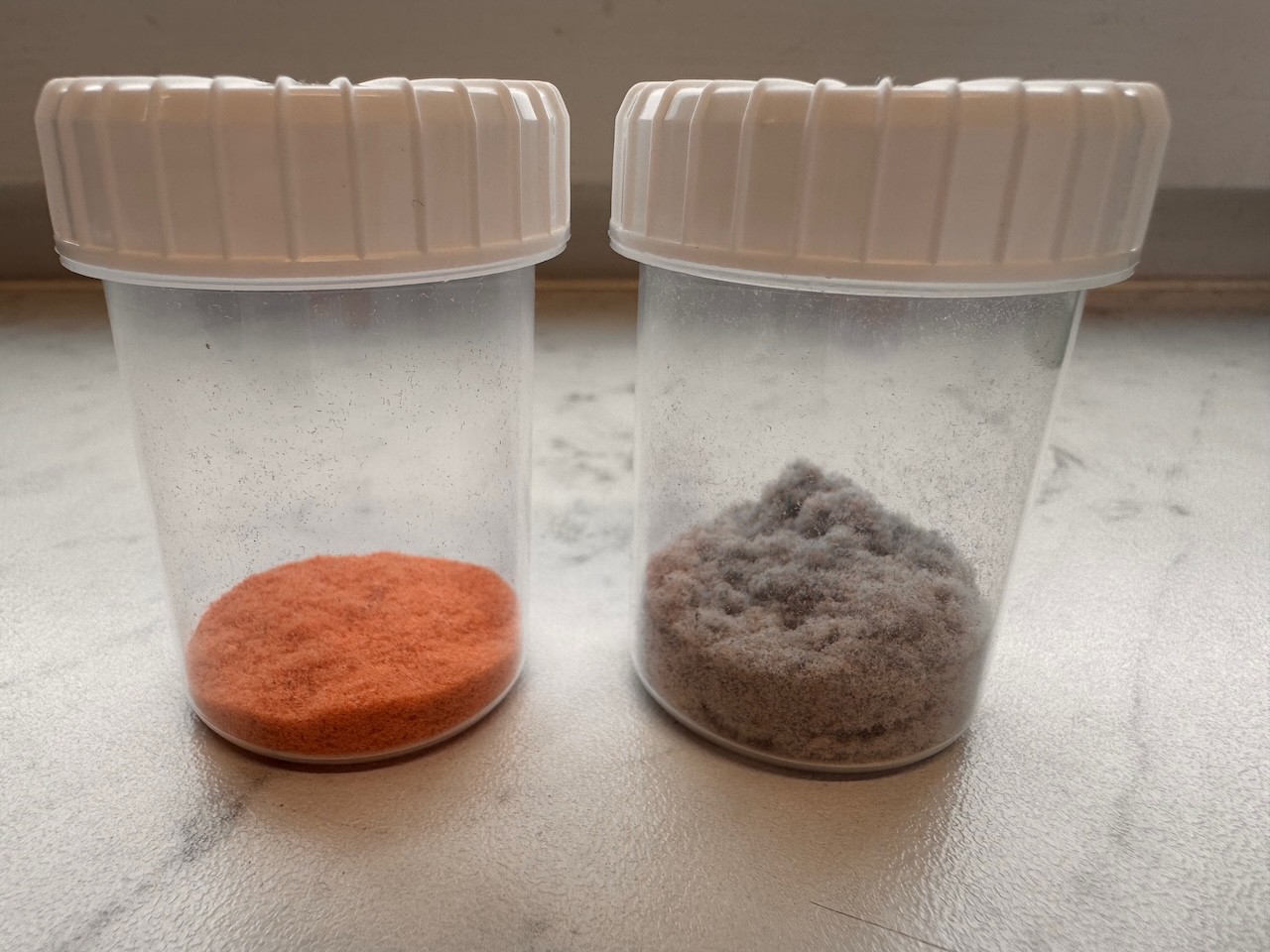
Sorted orange and grey fiber material

The Lab Phase Is Over. Every Process Step Works.

When FiberFlow received the EXIST Gründungsstipendium in October 2024, the technology existed only as an idea. One year later, the lab phase is complete. Every process step has been built and proven to work. The prototypes are done.

That is not a small thing. Moving from a concept to a functioning separation process, one that can take post-consumer textile waste and produce clean, single-fiber fractions, required solving a long chain of technical problems, one after the other. The Founders of FiberFlow spent the past year doing exactly that, working out of HTWK Leipzig with the focus the scholarship made possible.

What Was Proven

FiberFlow's process separates blended post-consumer and post-industrial textile waste into single-fiber fractions: polyester, cellulose, polyamide, polypropylene, acrylic, and elastane. Each step in that process has now been validated in the lab. Purity levels reach up to 99%, verified by FTIR spectroscopy.

The question that drove the lab phase "does the process actually work?" has been answered.

What Comes Next

Proving a process in the lab and producing material at a volume useful to a recycling customer are two different problems. That is the challenge FiberFlow is now turning to: scaling up production to a point where samples can be delivered to recycling companies running chemical, thermo-mechanical, or biological processes.

The path from lab prototype to sample-ready output requires a different kind of work than the year that just ended — more engineering, more capital, and the right partners. That is what the next phase is about.

Recycling companies interested in working with FiberFlow on sample material are more than welcome to get in touch through our Pioneer Program!
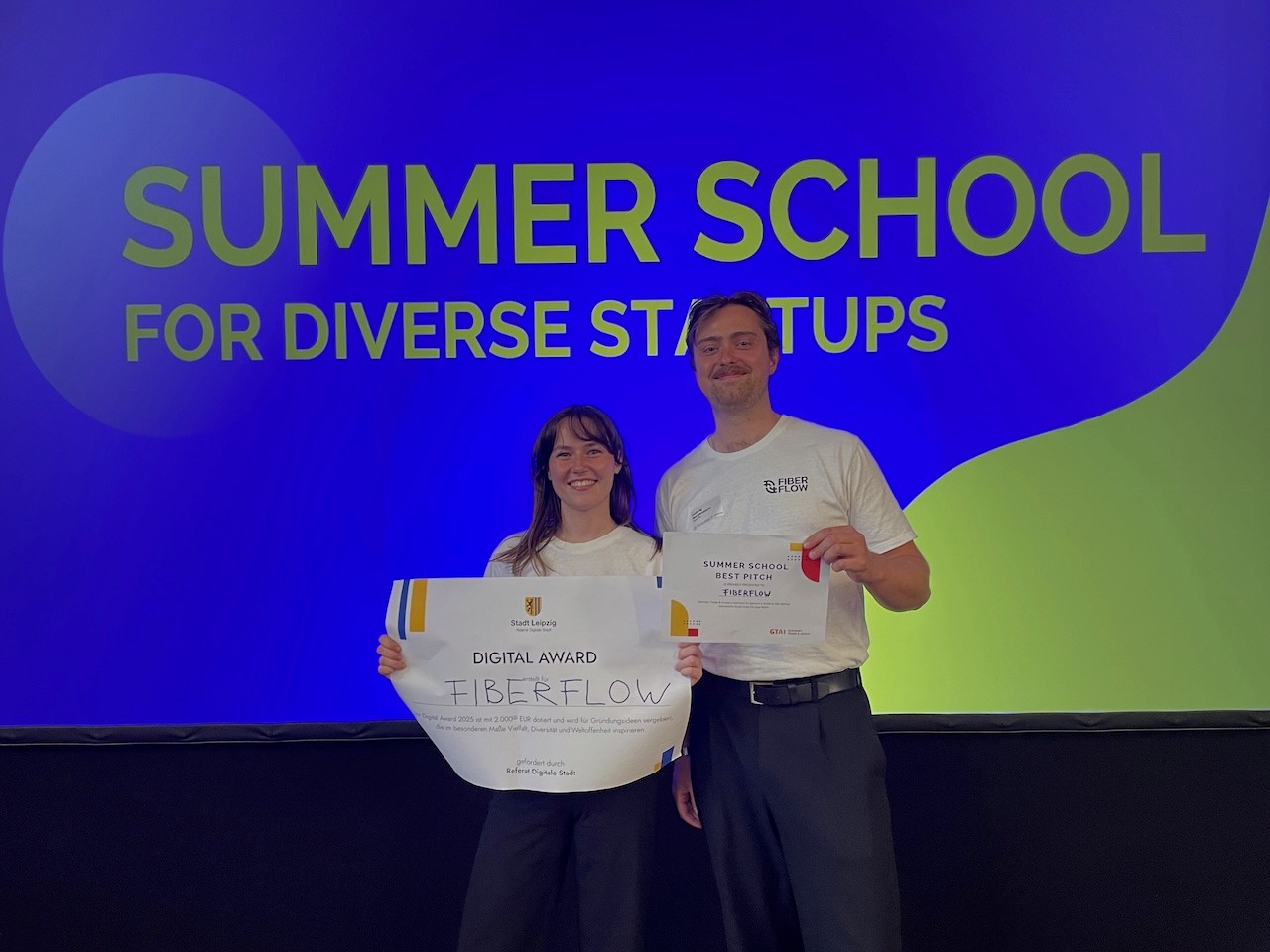
Co-Founders of FiberFlow, Ludwig and Lena, holding the Digital Award Prize Sign

FiberFlow Wins the Digital Award at SpinLab's Summer School for Diverse Startups

In July 2025, FiberFlow took part in the fifth edition of the Leipzig Summer School for Diverse Startups, run by SpinLab – The HHL Accelerator and HHL Digital Space. At the closing pitch event, FiberFlow won the Digital Award, presented by the City of Leipzig and endowed with €2,000.

What the Summer School Is

The Leipzig Summer School for Diverse Startups is a free, one-week acceleration programme for founders from underrepresented backgrounds, including women, people with international or migration histories, and others who are statistically underrepresented in the startup world. Now in its fifth year, the programme combines hands-on workshops on sales, marketing, and financing with 1:1 coaching, access to Leipzig's startup ecosystem, and a public pitch contest at the end of the week.

The programme is backed by a broad partner network including the City of Leipzig, EDIH Saxony, Dell Technologies, TGFS, and Germany Trade & Invest.

The Pitch Contest

The week's final event on July 24 brought together the participating teams to present their ideas before a jury of experts and a public audience. FiberFlow made its case for fiber-level separation of post-consumer textile waste and convinced the jury. The Digital Award, granted by the City of Leipzig, went to FiberFlow.